


What Does Quality Really Mean in a Casting? Inside the Foundry QC Lab
Every casting supplier says their parts are "high quality." But quality in metal casting isn't a feeling — it's a set of measurable properties, verified through specific tests, at specific stages of production.
When you buy a grate bar, a crusher liner, or any wear-resistant casting from SLINORD, you're not just buying a shaped piece of metal. You're buying a guarantee about its composition, its internal soundness, and its ability to survive your operating conditions.
In this post, we'll pull back the curtain on what happens inside a serious foundry's quality-control laboratory — the checks that separate castings that last from castings that fail.

Quality Control Starts Before the Metal Is Poured
A casting's fate is largely decided before the furnace door opens. Good QC begins with:
Raw material verification — incoming scrap and alloys are checked to ensure the melt starts with the right chemistry, not "close enough."
Process-controlled melting — temperature, atmosphere, and charge composition are monitored during the melt.
Pre-pour chemistry — a spectrometer reads the melt chemistry before a single mold is poured, catching out-of-spec heats at the source.
Catching a bad melt before pouring saves weeks of rework. Doing it after is too late.
The Five Tests Every Serious Foundry Runs
Here's the QC toolbox a capable foundry should have, and what each test tells you:
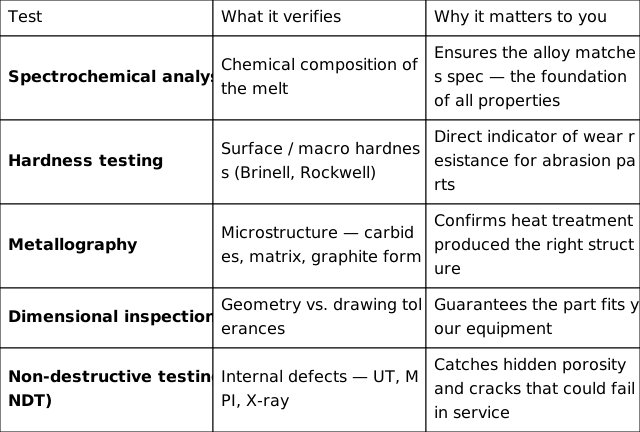
A part can pass hardness yet still be garbage if its microstructure is wrong. That's why serious suppliers run them together, not cherry-pick the cheapest test.
Why "It Passed Hardness" Is Not Enough
High-chromium and alloyed castings are complex. Two bars with identical hardness numbers can perform completely differently in service — because one has the right carbide structure and the other is brittle from improper heat treatment.
That's why metallographic examination matters. Under the microscope, a quality engineer can see:
Whether chromium carbides are evenly distributed in the matrix
Whether the matrix is the right phase (martensitic, austenitic, ferritic)
Whether there are harmful free carbides or excessive porosity
This is the difference between a foundry that measures quality and one that assumes it.
Traceability: The Backbone of Trust
Real quality control is traceable. Every SLINORD shipment carries documentation that ties each casting back to its origin:
Chemical composition report from the melt lot
Hardness and microstructure results from the heat treatment batch
Dimensional inspection records matched to your drawing
Heat number enabling full lot recall if an issue ever surfaces
When a part fails in the field, traceability is what lets you (and us) find the root cause fast — instead of guessing.
Questions to Ask Your Casting Supplier
Before you place your next order, ask these:
Do you have in-house spectrometry, or do you outsource chemistry?
Do you perform metallographic examination, or only hardness testing?
What NDT do you run, and on which parts?
Can you provide full heat-treatment records and lot traceability?
Is QC done by your own engineers, or delegated to the production floor?
The answers will tell you more about part reliability than any glossy brochure.
Built For Endurance
At SLINORD, our commitment to endurance isn't just a tagline. It's enforced in the QC lab — melt after melt, lot after lot. Whether you need high-chromium grate bars, incinerator grates, or custom wear-resistant castings, our quality system is built to give you components you can trust under load.
Contact us with your drawing or wear problem — we'll show you exactly how we'd quality-assure your part.
SLINORD — China Precision Casting Factory · Custom Iron & Steel Casting Supplier · Built For Endurance


