


Why Heat Treatment Decides Whether Your Casting Lasts — or Fails Early
A lot of buyers think the moment the mold opens, the casting is finished. It isn't.
Two castings poured from the exact same alloy — same chemistry, same geometry — can behave like completely different materials in service, depending entirely on what happens in the heat-treatment furnace after they leave the mold. A casting that arrives soft, brittle, or full of residual stress is a ticking time bomb, no matter how good the foundry's melting was.
At SLINORD, heat treatment isn't an afterthought. It's the step that locks in the mechanical properties your component actually needs. Here's what it does, and how to make sure your supplier gets it right.

Pouring Is Only Half the Job
As-cast metal has a natural microstructure that's inconsistent: uneven grain, residual stresses from uneven cooling, and hardness that varies from surface to core. The part may look perfect, but it's internally unstable.
Heat treatment reheats the casting to a precise temperature, holds it there, then cools it at a controlled rate. This single process:
Relieves internal stress that would cause warping or cracking later.
Tames the microstructure — turning brittle as-cast structures into a balanced matrix.
Sets hardness and toughness to the level the application actually requires.
Improves machinability for parts that need secondary machining.
Get it right and the casting wears, resists impact, and holds dimension for years. Get it wrong and you'll see cracking, premature wear, or parts that simply can't be machined.
The Core Processes You Should Know
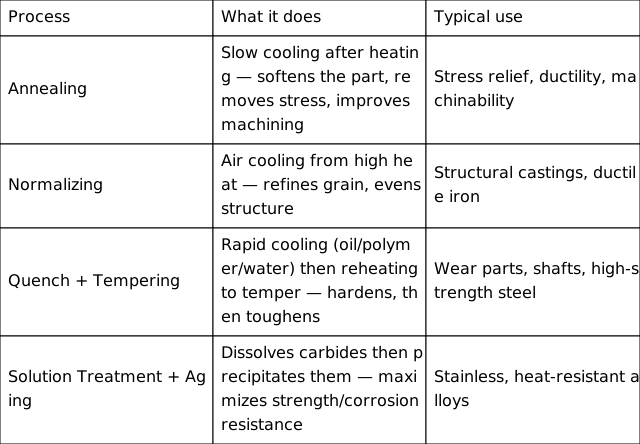
Wear-resistant high-chromium iron and heat-resistant stainless demand controlled quench-and-temper or solution treatment. Skip it, and the alloy never reaches the hardness and wear resistance you specified on paper.
Hardness Isn't the Only Number
A common buyer mistake is to ask only for a hardness value ("give me 45–55 HRC") and stop there.
Hardness is easy to measure and easy to fake. What actually determines service life is the microstructure underneath — is the matrix the right phase? Are the hard carbides evenly distributed? Is residual stress relieved? That's why a serious foundry pairs hardness testing with metallographic examination and documented temperature curves.
When you review a heat-treatment spec, you should ask for:
The exact process — annealing, normalizing, quench+temper, or solution treatment?
Temperature and hold time — not just "heat to required temp."
Cooling medium and rate — oil, polymer, forced air, or water?
Resulting hardness range with an acceptable band, not a single number.
Metallographic confirmation of the resulting structure.
Where Heat Treatment Goes Wrong
Treating the whole part the same. A component that combines heavy sections and thin walls cools unevenly. The process must account for section thickness, or the thin ends become brittle while the heavy core stays soft.
Skipping tempering after quench. Quenched steel is hard but dangerously brittle. The temper step is non-negotiable — it trades a little hardness for the toughness that prevents cracking.
No furnace records. Without logged temperature curves, "we heat-treated it" is a claim, not a guarantee. Real traceability means every lot has a documented thermal cycle.
The Foundry That Treats as a System
At SLINORD, heat treatment is integrated with casting design from day one: our engineers account for section thickness, alloy response, and your service conditions before we recommend a thermal cycle — then verify the result with hardness and microstructure checks on every lot.
That's what "Built For Endurance" actually means: not just pouring the right alloy, but locking in the properties that make it survive.
Contact us with your component and service conditions, and we'll design the casting — and the heat treatment — that matches the job.
SLINORD — China Precision Casting Factory · Custom Iron & Steel Casting Supplier · Built For Endurance


