


How to Choose a Casting Supplier You Can Actually Trust
Your casting supplier isn't just a vendor. They're the last line of defense between your design and the component that keeps your plant running — or shuts it down.

Pick the right foundry and you get parts that arrive on spec, on time, and last in service. Pick wrong, and you'll spend the next two years chasing rejects, downtime, and invoices for parts that never quite worked. This guide covers what to check before you commit.
Step 1: Verify Capability, Not Just Claims
Every foundry can say "we cast iron and steel." The question is whether they can cast your part to your standard. Before you ask for a quote, verify:
Alloy range — can they pour the specific grades your part needs (high-chromium, heat-resistant stainless, ductile iron)?
Casting size and weight limits — your part has to fit their equipment, comfortably.
Processes — sand, investment, or both? Which one matches your tolerance and finish requirements?
In-house finishing — machining, heat treatment, NDT. If these are outsourced, that's a handoff point where quality can slip.
Ask for a list of similar parts they've produced. A foundry that has cast components for your industry has already solved the problems you'll hit.
Step 2: Look at Their Quality System
Quality isn't a department; it's a system. A trustworthy supplier can show you:
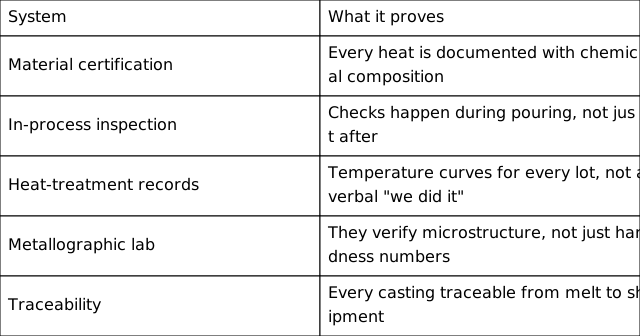
If a foundry can't produce documented quality records on request, that's not a "we'll get them for you" — that's a red flag.
Step 3: Test Their Engineering Depth
The best foundries treat your drawing as a starting point, not a finished instruction. When you send them a part, they should:
Review castability — flag thin sections, sharp corners, or uneven walls that will cause defects.
Suggest alloy improvements — if a cheaper or stronger grade fits your service, they should say so.
Recommend process changes — sometimes a small geometry tweak doubles the casting's life.
This is where a foundry earns its keep. A supplier that just takes your order and pours is a commodity; a supplier that asks questions is a partner.
Step 4: Define What "On Time" Means
Late castings shut down production lines. Before you commit, clarify:
Lead time — for prototypes, first production, and reorders. They should differ.
Capacity — can they handle your peak volumes without slipping your deadlines?
Communication — who's your contact, and how quickly do you get a status update?
Change management — what happens when a drawing or order changes mid-production?
Put it in writing. Handshake agreements evaporate when a shipment slips.
Step 5: Evaluate Total Cost, Not Unit Price
The cheapest per-kilo quote is rarely the cheapest part. A low-bid casting that fails early, needs extra machining, or arrives out-of-spec costs more than a premium part that drops in and lasts.
Compare total cost per installed, working part — quote price plus machining, scrap, rework, and the downtime cost of early failure. And be wary of quotes that undercut everyone by 30%: in casting, that kind of gap usually comes out of alloy, heat treatment, or inspection.
The Checklist Before You Sign
They've cast parts like yours before
Material certs and traceability are standard, not special
Metallographic lab is in-house
Engineering team reviews drawings and pushes back
Lead times and capacity match your production needs
Total cost per working part beats the alternatives
Partner With a Foundry Built For Endurance
At SLINORD, we've built our reputation on precision investment casting for wear-resistant and high-temperature components — grate bars, incinerator grates, crusher parts, and custom alloy castings for industries where failure isn't an option.
We'll show you our quality records, review your drawings honestly, and quote total cost per working part — not a number that looks good on paper.
Contact us with your drawing or wear problem, and let's see if we're the right partner for the job.
SLINORD — China Precision Casting Factory · Custom Iron & Steel Casting Supplier · Built For Endurance


